
Borrowing an audience you haven't built yet
At launch your own audience is small. Other people already have the one you want: a newsletter writer in your niche, someone with a YouTube channel reviewing tools in your category, a consultant whose clients keep asking for what you sell. An affiliate program pays them a share of each sale their audience sends you.
Most of the work is deciding things before the first message goes out: what you pay, for how long, when you pay it, and what partners must tell their audience. Change those after partners have started promoting you and someone ends up feeling cheated. This post goes through the four terms, refunds and chargebacks, the FTC's disclosure rules for partners and for you, and a one-page agreement to send.
This is practical guidance, not legal or tax advice. The disclosure and tax sections are US rules.
The four terms to decide before the first message
What you pay: rate, and recurring or one-time
A one-time commission pays a percentage of the first payment. A recurring commission pays a percentage of every payment the customer makes, for as long as the terms say.
For a subscription product the difference is large. At $29 a month, 30% one-time is $8.70, once. At 30% recurring it's $8.70 a month, so $104.40 if the customer stays a year. A creator deciding whether to make a video about you does that sum. LaunchBeam's default is 30% recurring, because a one-time cut of a small monthly price is rarely worth someone's video. That's our view, not a market rate. There's no standard figure, and anyone who quotes one is guessing.
Write down what the percentage applies to. We'd use cash actually collected: after discounts, before sales tax or VAT, and net of refunds. A percentage of the list price pays partners for money you never received.
If "recurring" sounds open-ended, cap it. "30% of every payment for the first 12 months" is still recurring, and your liability has an end date.
How long a click counts: the attribution window
The attribution window is how long after someone clicks a partner's link a purchase still credits that partner. Most programs credit the last partner click before the purchase.
Set it from how your customers buy, not from what other programs use:
- Longer than your trial. If you offer a 14-day trial, a 7-day window credits only people who pay early. Window length should be the trial length plus however long people usually take to start the trial.
- Not so long it credits luck. A 365-day window pays a partner for someone they reached once, a year before your own email brought them back.
On recurring terms, say whether the window applies only to the first purchase. Most partners will assume a customer they brought in keeps paying them on renewals, whenever the renewals happen. Put it in writing either way.
When you pay: hold commissions until refunds are settled
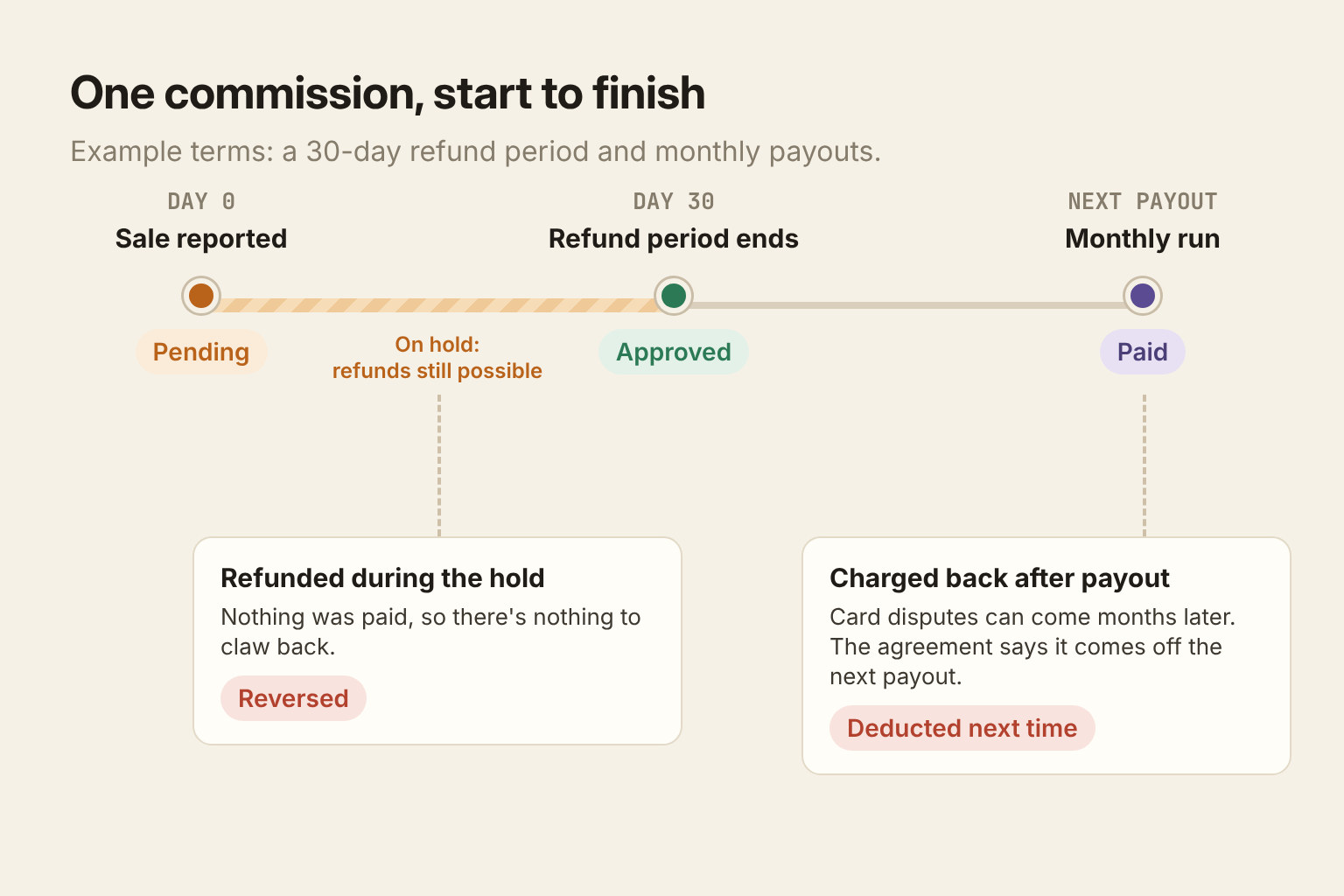
Paying a commission on a sale that's later refunded means asking a partner for money back. That conversation rarely goes well. Hold each commission until the sale is unlikely to unwind:
- Refunds: at least your own refund period. With a 30-day money-back guarantee, a commission is pending for 30 days.
- Chargebacks: longer. Stripe's dispute documentation says card networks typically let cardholders dispute a payment within 120 days, and longer in some cases. You can't wait that long for every payment, so the agreement should say that a commission on a payment later charged back comes off the next payout.
A common shape is monthly payouts, covering commissions older than your refund period, with a minimum balance so you're not sending $3 transfers. The specific numbers are yours to choose. The important part is that partners see them before they start.
What partners may and may not do
Their promotion is legally partly yours (more on that below), so set the rules on day one:
- Always disclose the commission, in the words and the place set out below.
- No bidding on your brand name in search ads, and no coupon-code sites, unless you allow it.
- No claims you can't back up, such as "saves 10 hours a week" with no source.
- No fake reviews, and no reviews of your product posted without disclosure.
- No spam: no bought lists, no unsolicited mass DMs.
Disclosure: what the FTC expects from partners
The FTC's Endorsement Guides, revised in 2023, say that when a connection between an endorser and a seller could affect how much weight the audience gives an endorsement, and the audience wouldn't expect it, the connection has to be disclosed clearly and conspicuously. Earning a commission on each sale is that kind of connection. "Clearly and conspicuously" means hard to miss and easy for ordinary people to understand.
The FTC's plain-language Q&A, FTC's Endorsement Guides: What People Are Asking, gets specific about affiliate links:
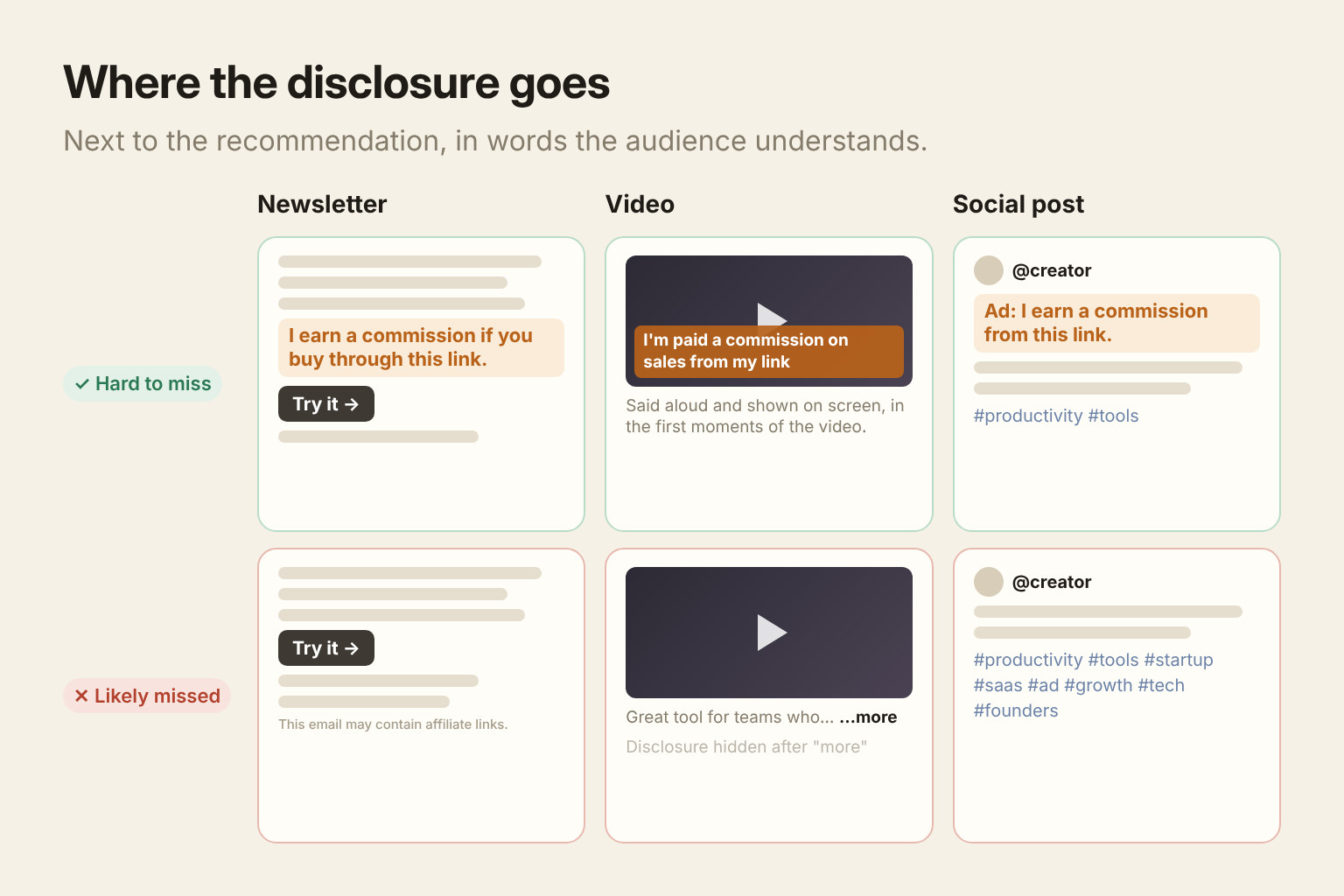
- "Affiliate link" on its own may not be enough. The FTC says consumers might not understand that it means the person is paid for purchases through it. Its example of plain wording is: "I get commissions for purchases made through links in this post."
- Put it where the recommendation is. The reader should be able to see the disclosure and the link at the same time. A disclosure on a separate page, or at the bottom of a long post, can be missed.
Its guide for creators, Disclosures 101 for Social Media Influencers, adds the platform cases:
- Not only in the profile. A disclosure that appears only on an About page or bio, at the end of a post or video, or behind a "more" click is likely to be missed.
- In the video itself. For a video review, say it in the video, not only in the description. Saying it and showing it on screen is better still.
- Not buried in hashtags.
#adlost among ten other hashtags doesn't count as hard to miss.
Disclosure: what the FTC expects from you
You can't hand the problem to your partners. The Endorsement Guides make advertisers liable for misleading claims made through their endorsers, and for endorsers' undisclosed connections. The FTC's Q&A says an advertiser with a network of affiliates should have a reasonable program to train and monitor them, scaled to the risk. There's no one-size-fits-all standard.
For a launch-sized program, a reasonable version looks like this:
- Give partners the exact disclosure sentence and where to put it: top of the post, next to the link, spoken in the video.
- Give them the claims they may make, and tell them which ones they may not.
- Look at what they publish. Check each new partner's first post, then spot-check the rest.
- Act when something's wrong. Ask for a fix, and pause the partner if it doesn't happen. Write down that you did.
If you recruit partners from your own happy customers (often the best ones), their earlier unpaid reviews stay as they were. Anything they write after they start earning commission needs the disclosure.
Links and search engines
Google asks sites that take part in affiliate programs to mark those links rel="sponsored" (or nofollow), and treats paid links that aren't marked as a link-spam problem. See qualifying outbound links. It's the partner's page, so it's their markup, but put it in the agreement. A partner who gets penalised for unmarked links stops sending you traffic.
Paying partners: tax paperwork in the US
US businesses report payments to independent contractors on Form 1099-NEC. For payments made after December 31, 2025, the reporting threshold rose from $600 to $2,000, under the 2025 tax law (IRS Form 1099-NEC FAQ). Collect a W-9 from US partners before the first payout, and the matching W-8 form from partners abroad. Ask your accountant which applies to you before your first payout.
Where to find the first twenty
The best launch partners already talk to your customers about your problem:
- YouTube, searched with your customer's words, not your product category. A video with a few thousand views on the exact problem means the audience is already gathered.
- Creators who reviewed the tool you replace. They've shown they'll make content about this category.
- Niche newsletters with a sponsorship page. It means they already say yes to this kind of deal.
- The people who answer the same question in your customer's communities, week after week. They're the ones people trust for a recommendation.
- Customers who've already praised you in public. Ask whether they'd like to be paid for it, and remember the disclosure rule changes when they say yes.
Write to each one personally: why them, what the product does for their audience, and the terms in one line. Twenty careful messages beat two hundred pasted ones. If you launch on Product Hunt, its rules on asking for upvotes apply to your partners too, so tell them to ask for comments, not votes.
A one-page partner agreement
Before anyone promotes you, send each partner a page that answers:
- Rate and type: for example, 30% of every payment for 12 months, or 30% of the first payment only.
- Base: cash collected, after discounts, before tax, net of refunds.
- Attribution: window length, last click, and whether renewals count after the window ends.
- Payouts: when commissions become payable, how often you pay, the minimum balance, and how.
- Refunds and chargebacks: reversed if refunded during the hold, deducted from the next payout if it happens later.
- Disclosure: the exact sentence and where it goes.
- Allowed and prohibited tactics, and which claims are off-limits.
- Paperwork: the tax form you need before the first payout.
- Ending it: either side can stop with notice, and what happens to pending commission when they do.
Where LaunchBeam fits
LaunchBeam's Affiliates page is a recruiting pipeline and a commission ledger for one product at a time. Partners move from prospect to contacted, accepted and active, and a partner gets a permanent tracked /a/ link when you mark them accepted. The link never changes, so it keeps working in every video description they've already published.
Terms default to 30% recurring with a 60-day attribution window, and you can change them per partner. The rate is copied onto each commission line when it's booked, so changing a partner's terms affects future sales only. A line is booked when your own product reports the sale to LaunchBeam's conversion webhook, with the visitor id from the partner's link and your product's secret. A retried report with the same charge id doesn't book twice, and a sale reported without an amount books no commission rather than a guessed one. On one-time terms, only the first purchase from the same visitor is credited.
LaunchBeam checks the attribution window against the partner's click for every purchase it's told about, renewals included. If your terms pay renewals for longer than the window, lengthen the window to match. Bear in mind that a longer window also gives a first purchase longer to count.
Every line starts as pending. An owner or admin approves it once your hold period has passed, or reverses it after a refund or chargeback. Record payout logs a payment you made elsewhere and works out the total from the approved lines it settles. LaunchBeam doesn't move money and isn't connected to your payment processor, so refunds don't reverse lines automatically, and you decide when the hold is over.
The affiliate kit writes swipe copy in the partner's voice for their audience, including a disclosure sentence. Before you send it, check that the sentence says plainly that the partner earns a commission, and tell partners to put it next to the link, not at the end. Where to find partners on the same page lists the five places above. Partner clicks also show up in Analytics as channels under each partner's name, next to your directories and posts. Our attribution guide covers how to read them.