
Social proof before you have customers
A launch page wants testimonials on day one, and on day one you have almost nobody to quote. That gap pushes founders toward shortcuts: a placeholder quote that ships, a glowing line from a cofounder, an AI-written review "from a beta user", a few bought followers so the account looks established.
In the US, most of those are now covered by a federal rule with civil penalties, not just advice about good practice. This post sets out what the FTC's rule bans, what you can still ask and pay for, how testimonials about results work, and the records worth keeping.
It's a plain-language summary of US rules, not legal advice. Other countries have their own.
The rule in one paragraph
The FTC's Trade Regulation Rule on the Use of Consumer Reviews and Testimonials, 16 CFR Part 465, was announced on August 14, 2024 and took effect on October 21, 2024 (FTC announcement). Because it's a trade regulation rule, the FTC can seek civil penalties from businesses that knowingly break it. That's the change: before it, the FTC's options against a first offence were mostly limited to an order to stop. In December 2025 FTC staff sent warning letters to ten companies, which put the maximum penalty at $53,088 per violation.
What the rule prohibits
| Section | What it bans | What it looks like at launch |
|---|---|---|
| 465.2 | Reviews and testimonials that misrepresent that the reviewer exists, that they used the product, or what their experience was. Writing them, buying them, and spreading them when you knew or should have known they were false. | A template's placeholder quote that ships to production. An AI-written quote credited to "Sarah K., Product Manager". A quote from a beta tester who never logged in. |
| 465.4 | Offering money or anything else in exchange for reviews that express a particular sentiment, whether the condition is stated or implied. | "Leave us a five-star review and get a month free." |
| 465.5 | Reviews and testimonials from officers, managers, employees or agents without a clear disclosure of the connection, plus limits on asking employees and their relatives to post reviews. | A cofounder's review on a directory listing. Asking the team to review the product on launch day without telling them to disclose. |
| 465.6 | A website that claims to give independent reviews of products like yours but is controlled by you. | A "best tools for X" comparison site you own that ranks you first. |
| 465.7 | Unfounded legal threats, intimidation or false public accusations to get a review removed. Also, presenting the reviews you show as all or most of them while you've hidden the negative ones. | Threatening a critic with a lawsuit. A review widget that quietly drops anything under four stars. |
| 465.8 | Buying or selling fake followers, views or other social indicators, when they're used to misrepresent influence for a commercial purpose. | Buying followers before launch so the account looks established. |
The FTC's announcement names AI-generated fake reviews as an example of a review by someone who doesn't exist. The suppression section has exceptions: you can withhold reviews for reasons that apply to every review alike, such as content that's defamatory, harassing, obscene or discriminatory, or that's clearly false.
Your own website counts
It's tempting to read "reviews" as something that happens on other people's platforms. The FTC's questions and answers on the rule say otherwise: a business that puts testimonials on its own website is disseminating them, not just hosting them, and is liable if they're fake or false.
So the rule covers the quotes on your landing page, your waitlist page and your press kit, and the review screenshots in your launch posts. It covers anything you choose to show.
Asking for reviews: what's allowed
You can ask customers to review you, and you can thank them for it. Where it goes wrong is in who you ask and what the reward depends on.
Ask everyone, or a fair sample. The FTC's guide for marketers, Soliciting and Paying for Online Reviews, says not to ask only the customers you think will be positive. Its Endorsement Guides Q&A explains why: asking only likely-happy customers is misleading if it substantially skews how favourable the reviews look. That includes the common "Happy? Review us. Unhappy? Email us." flow, known as review gating.
An incentive is allowed if it doesn't depend on the sentiment. "A month free for an honest review, good or bad" isn't conditioned on a sentiment. The FTC's Q&A says that expecting an incentivised review to be positive doesn't, by itself, make positivity a condition. The same Q&A warns that not disclosing an incentive can still break the FTC Act. So ask reviewers to mention what they received, and check each review site's own rules first. Some ban incentives outright.
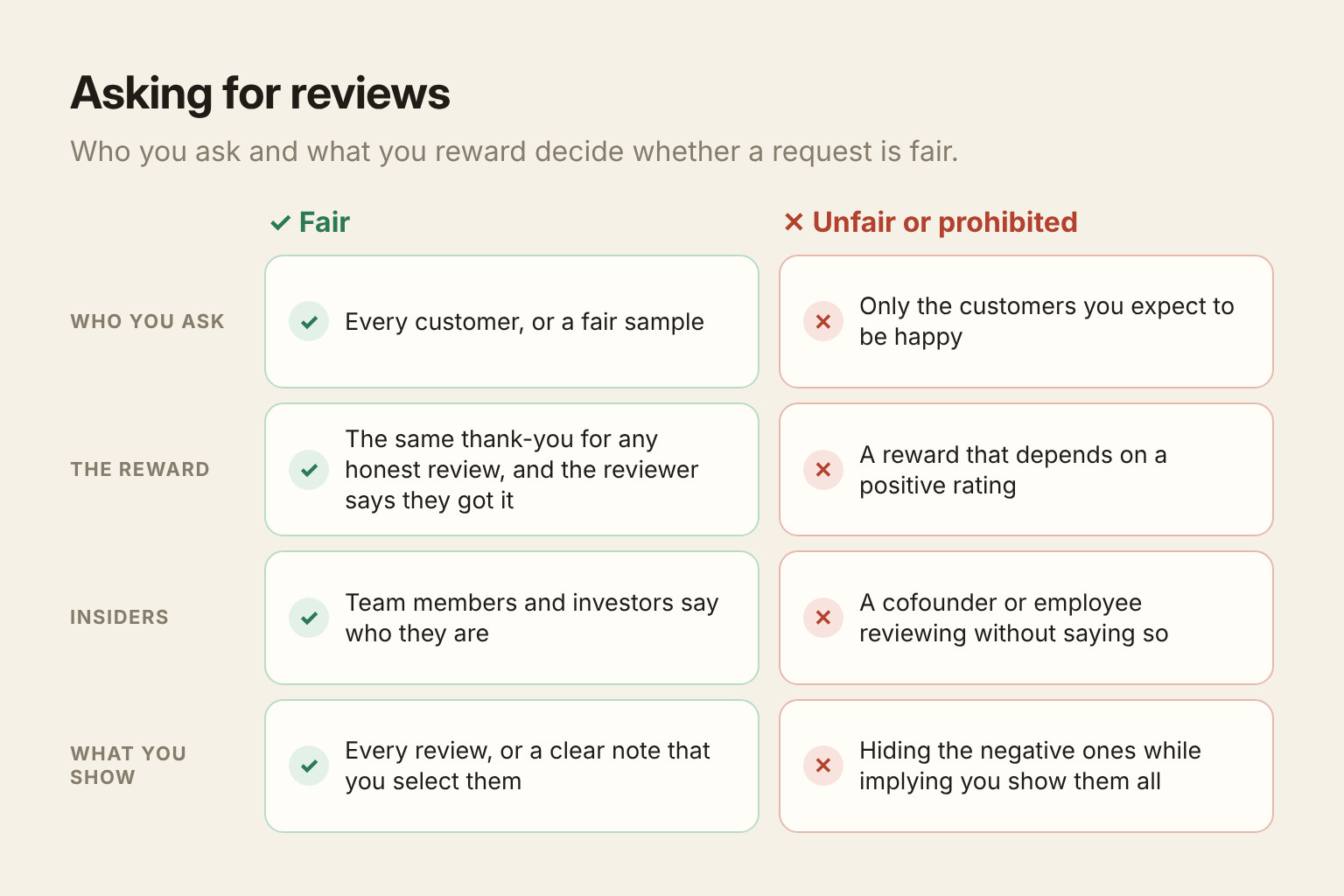
Insiders disclose. A review from someone who works for you, or holds a stake in you, needs to say so where readers will see it. The same goes for paid partners. Our affiliate guide covers what a clear disclosure looks like.
Launch platforms add their own rules on top of the FTC's. Product Hunt, for one, doesn't allow asking for upvotes, which our Product Hunt guide covers.
Testimonials that describe results
The older Endorsement Guides, revised in 2023, still govern testimonials, and they matter most when a quote describes a result.
- A result is a claim. A customer quote saying "it cut our support tickets in half" is treated as you claiming the product does that. Unless you can show that's what customers generally get, you have to disclose clearly what they generally do get. A small-print "results not typical" is unlikely to be enough.
- It has to be their honest view. The endorsement must reflect what the person actually thinks and experienced. Don't trim a quote until it says something they didn't mean.
- They have to have used it. The person must have been a real user when they gave the quote. You can keep showing it only while you have good reason to believe they still are.
At launch, a result from one enthusiastic beta team is a sample of one. Quote the experience ("we set it up in an afternoon") rather than a metric, or show the metric with what typical users see.
The beta-user problem
Most launch testimonials come from beta users, and that's fine. They used the product, so their experience is real. Three things need care:
- Disclose what they got for it. Free lifetime access in exchange for feedback, a discount or a payment is a connection readers would want to know about. Put it next to the quote: "Received free access during the beta."
- Disclose who they are to you. Friends, family, investors, advisors and former colleagues all count.
- Keep the quote their own. Light edits for length are normal. Changes to meaning aren't. Show the edited version to the author before it goes live.
If you have nothing yet, show something true instead: a short demo, a precise description of what the product does, or a real number you aren't padding. An empty testimonials section costs you less than a false one.
Keep the paper trail
Part 465 doesn't prescribe a consent form. But using someone's name, words and face in your marketing without asking causes trouble well beyond the FTC, and permission is the first thing you'll be asked to show when someone objects. For each quote, we'd record:
- who said it, and where it came from: an email, a call, a support ticket or a public post
- when they said it, the original wording, and any edits they approved
- that they agreed to be quoted, how and when
- anything they received: free access, a discount, payment
- whether they still use the product
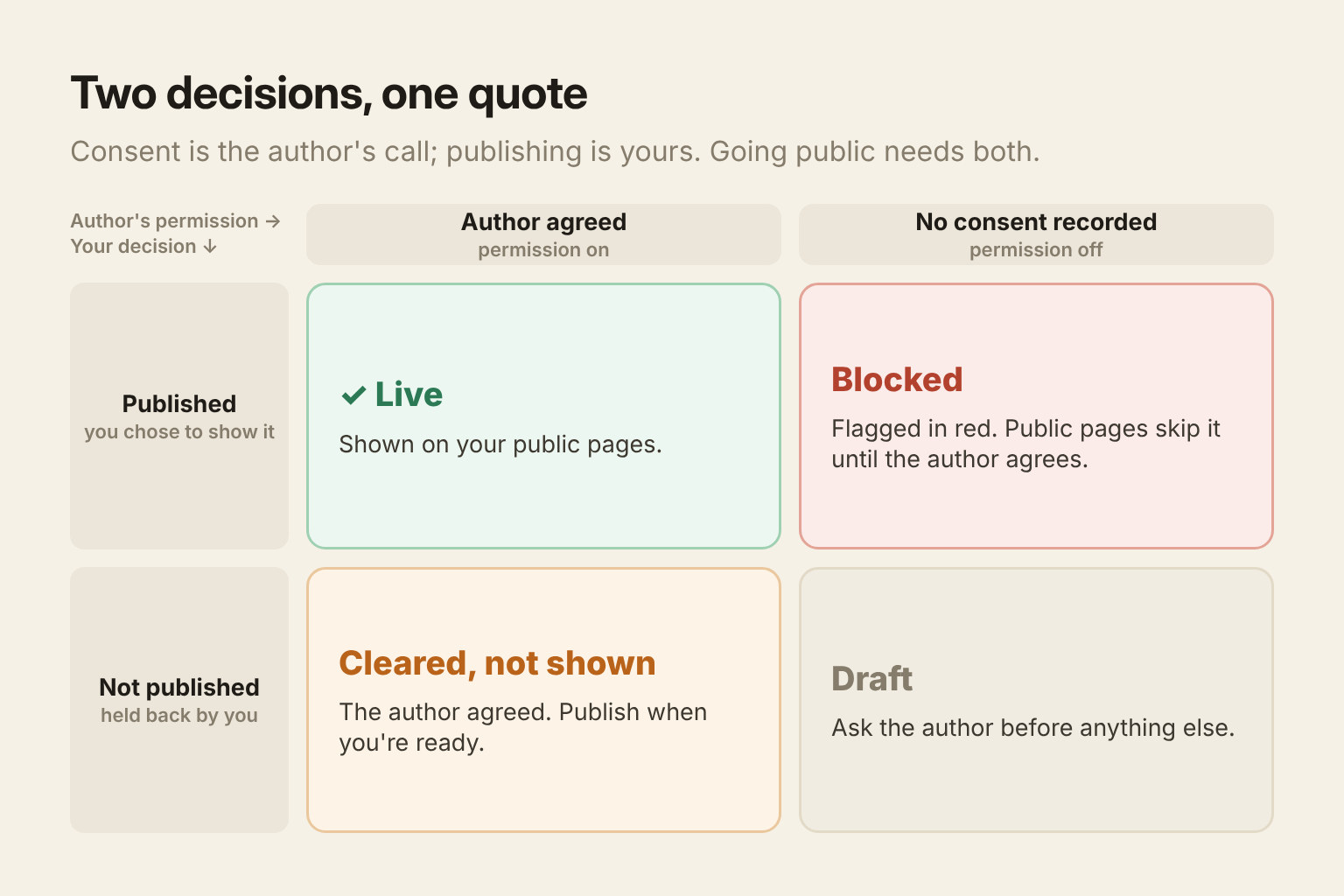
Then keep consent and publishing as two separate decisions. The author's yes is one fact. Your choice to show the quote is another. A quote goes live only when both are true, and comes down the moment the author withdraws.
A pre-launch social-proof checklist
- Delete every placeholder testimonial from your templates and page builder before launch, not after.
- For each quote, confirm the person exists, used the product and agreed to be quoted, and keep the record.
- Add a disclosure line next to any quote from someone who got something for it, works with you or knows you.
- Check result claims. Show the typical result, or quote the experience instead of a number.
- Ask for reviews from everyone, or a fair sample, not only your fans.
- Make any thank-you independent of the rating, and ask reviewers to mention it.
- Tell the team to disclose their role in any review or launch-day comment.
- Show every review in a review widget, or say clearly that you select them.
- Don't buy followers, views or upvotes.
Where LaunchBeam fits
LaunchBeam's Testimonials page keeps the two decisions apart. Each quote has an Author gave permission switch and a Published switch, and a quote appears publicly only when both are on. Public means your press kit, and the published waitlist page, which shows up to three of the most recent such quotes. Any workspace member can turn permission off, so "take my quote down" never waits for an admin. Publishing is limited to owners and admins.
If a quote is marked published with no permission recorded, the row turns red and the public pages skip it. Each quote also records where it came from and, optionally, an author photo chosen from the product's own images.
The waitlist page shows a signup count only once at least 25 people have joined. It's a live count of people still on the list, not a number you type in.
LaunchBeam can't tell whether a quote is genuine. It keeps the record you give it, so the record is only as good as what you put in. The Press kit page is where those quotes reach journalists, and our launch directories guide covers the review sites where most launch reviews end up.